Quick answer: IPL (intense pulsed light) is the right tool for diffuse photoaging, sun spots, broken capillaries, mild rosacea redness, and uneven tone, on Fitzpatrick I to III skin. It does not fix deep wrinkles, true scarring, or severe melasma, and it is generally unsafe for Fitzpatrick IV to VI skin. Expect 3 to 5 sessions, minimal downtime, and visible improvement in pigment within 2 weeks of the first treatment.
If your skin in your forties suddenly looks like a map of your beach years, brown spots, broken capillaries on the cheek, a flushed look that does not calm down, IPL is one of the first tools we reach for. It is also one of the most over-promised devices in aesthetics, so it is worth being precise about what IPL does well, what it does not do, and who should not have it at all. For broader context our laser treatments guide covers the full energy-based device menu.
How IPL works
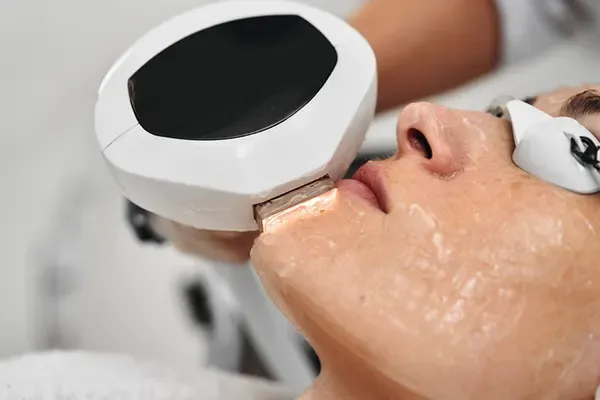
IPL stands for intense pulsed light. Unlike a laser (which produces a single coherent wavelength), IPL emits a filtered broadband spectrum, typically 500 to 1200 nm. The provider applies cutoff filters to select a sub-range of that spectrum that matches the target, a shorter cutoff (500-560 nm) for superficial pigment, longer cutoffs (590-755 nm) for vessels and deeper pigment.
The light is absorbed by two main chromophores in skin:
- Melanin in sun spots, freckles, and lentigines, heated, fragmented, then cleared by the body
- Hemoglobin in small blood vessels, heated, the vessel walls coagulate, the body resorbs the vessel
This dual-chromophore action is why one IPL session can address both brown and red components of photoaging on the same pass. A wavelength-specific laser would need separate handpieces or settings.
What IPL treats well
- Solar lentigines (sun spots): Flat brown spots from cumulative UV. IPL is excellent here; spots darken then exfoliate within 5-10 days.
- Diffuse facial redness and flushing: Mild rosacea and post-inflammatory erythema respond well to longer-cutoff filters.
- Telangiectasias (broken capillaries): Thin vessels on the cheeks, nose, and around the nostrils.
- Poikiloderma of the chest and neck: The classic V-shaped sun damage with mixed brown and red.
- Mild melasma in select patients: Cautious settings only; IPL can sometimes worsen melasma, so this is a judgment call and not a default recommendation.
- General skin texture and “glow”: Patients often report smoother, brighter skin from the cumulative collagen response, although this is a side benefit, not the primary indication.
What IPL does not fix
- Deep wrinkles or skin laxity. IPL is not a tightening device. For that, consider RF microneedling or skin tightening options.
- Acne scarring. True ice-pick or boxcar scars need fractional ablative laser or RF microneedling.
- Severe melasma. Often worsened by IPL; melasma needs a more layered approach (topicals, sun avoidance, sometimes carefully chosen lasers).
- Deep dermal pigment. Hori’s nevus, nevus of Ota, and similar deep pigment do not respond to IPL. They need Q-switched or picosecond lasers.
- Tattoo ink. See our laser tattoo removal cost piece, IPL is not the right tool for ink.
Who is a candidate?
The cleanest IPL candidate looks like this:
- Fitzpatrick skin type I, II, or III
- Brown and/or red components on a sun-damaged face, chest, or hands
- No active tan and no plan to tan within 4 weeks of treatment
- No active rosacea flare or acute inflammation
- Not pregnant or breastfeeding
- Not on a photosensitizing medication (some antibiotics, retinoids, certain diuretics) within their washout period
IPL is generally contraindicated for Fitzpatrick IV-VI because the broad spectrum is heavily absorbed by epidermal melanin, raising the risk of burns, hypopigmentation, and post-inflammatory hyperpigmentation. For darker skin tones with photoaging concerns, we use different tools, Nd:YAG for vessels, gentle fractional non-ablative lasers, or layered topical regimens. Honesty here matters more than completing a sale.
What does the research show?
IPL has decades of clinical literature behind it. A representative dermatology review reports significant improvement in lentigines and telangiectasias across multiple controlled series, with safety profiles strongest in skin types I-III (Babilas et al., Lasers Surg Med 2010). For rosacea-associated erythema and flushing, controlled trials have documented meaningful reductions in redness and flushing episodes after 3-4 sessions (Mark et al., Dermatol Surg 2003).
Long-term photoaging series suggest that maintenance IPL (1-2 sessions per year) combined with daily broad-spectrum SPF preserves the result and slows the appearance of new pigment.
What the session looks like
- Cleanse and assess. Skin is cleansed; we review your concerns and check for any active tan.
- Eye protection. Opaque eye shields for you, protective glasses for the provider.
- Cooling gel applied. A clear gel between skin and handpiece for cooling and optical coupling.
- Filter and parameters selected. Based on Fitzpatrick type and target, typically a 560 nm or 590 nm filter for facial work.
- Pulses delivered. Quick flashes of light across the treatment area; ~15-30 minutes for a full face.
- Post-treatment cooling. Cold compress for 10-15 minutes, mineral SPF before you leave.
Sessions, spacing, and maintenance
Downtime and aftercare
- Mild pink for a few hours, occasionally mild swelling for 24 hours
- Treated brown spots darken to a “coffee grounds” look at days 2-3, then flake off by day 7-10, do not pick
- No exercise, hot showers, or saunas for 24 hours
- Daily broad-spectrum SPF 50 (this is non-negotiable for keeping the result)
- Hold actives (retinoids, AHAs, BHAs) for 5-7 days post-treatment
- Mineral makeup acceptable from day 1 if there is no blistering
Side effects and risks
- Common, mild: Redness, mild swelling, darkening of treated spots (the intended response).
- Uncommon: Blistering or superficial burn, usually from overtreatment or unrecognized tan; resolves with bland wound care.
- Possible: Post-inflammatory hyperpigmentation, especially if sun exposure occurs in the weeks after treatment.
- Rare: Hypopigmentation (loss of pigment); paradoxical worsening of melasma; rarely, scarring with significant overtreatment.
Related treatments at our Mission Viejo clinic
Not sure which treatment fits? These are the related services our clinicians most often discuss at a consultation.
- IPL Therapy for Skin Renewal and Clear Glow Results!, Discover IPL Therapy to reduce pigmentation, acne, and sun damage.
- Erbium Laser Treatment for Smooth Clear Skin Now, Discover erbium laser treatment to reduce wrinkles, scars, and sun damage.
- Laser Vein Removal for Clear and Healthy Skin Now, Treat visible veins with laser vein removal.
References
- Systematic review and meta-analysis of randomized clinical trials comparing efficacy, safety, and satisfaction between ablative and non-ablative lasers in facial and hand rejuvenation/resurfacing — Lasers Med Sci 2022, via PubMed
- Intense Pulsed Light on skin rejuvenation: a systematic review — Arch Dermatol Res 2022, via PubMed
- A systematic review of comparative studies of CO(2) and erbium:YAG lasers in resurfacing facial rhytides (wrinkles) — J Cosmet Laser Ther 2017, via PubMed
- Treatment of Solar Lentigines: A Systematic Review of Clinical Trials — J Cosmet Dermatol 2025, via PubMed