Prescription appetite suppressants
Three oral options, prescribed after a proper history rather than a form. Faster and far cheaper than a GLP-1, intended for shorter use, and not right for everyone.
Medically reviewed by Lindsay Short, NP-BC, Board-Certified Nurse Practitioner · last reviewed September 2026

What we prescribe, and what it costs
- Phentermine 37.5 mg
- Phendimetrazine
- Diethylpropion
- Consultation and InBody scan
Appetite suppressants are quoted per month, and which of the three suits you depends on how you tolerate them rather than on a ranking.
- Quoted in writing before anything starts. You hear the full figure at your consultation, not after treatment and not on the day.
- The consultation is free, with no obligation to book and no charge if you decide against it.
- We do not bill insurance. No prior authorization, no coverage denial part-way through, and no treatment decision made by a plan rather than by your clinician.
- Cherry and CareCredit financing are available, and membership pricing is lower than standard rates.
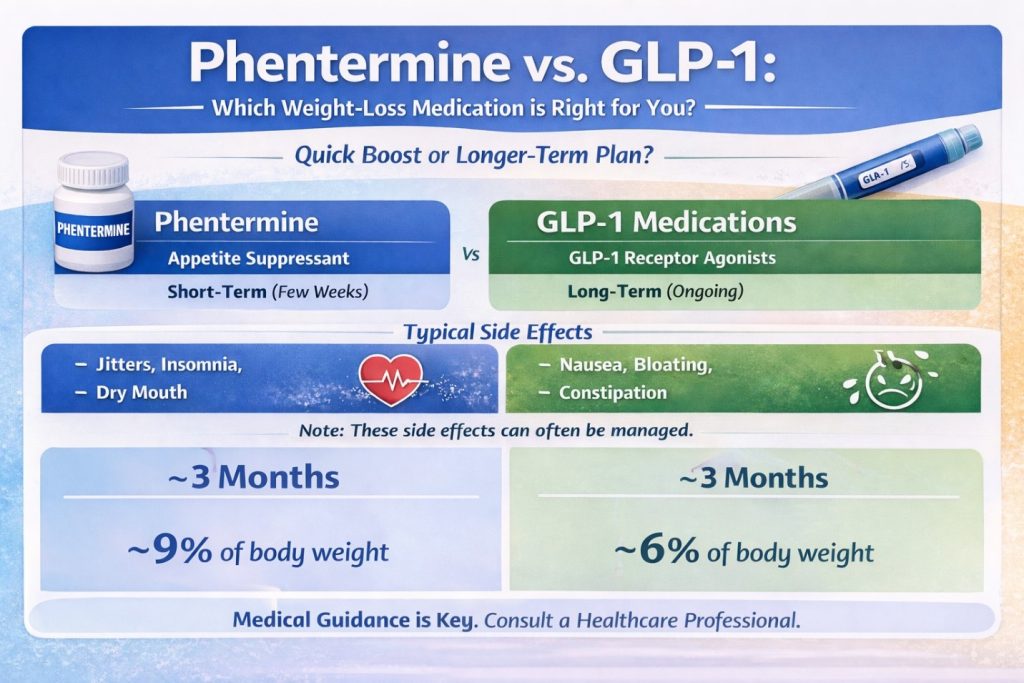
These are the oral options. They are stimulants, they reduce hunger directly, and they work within days rather than months. That combination, inexpensive, fast, short-term, is what makes them a genuinely different proposition from a GLP-1 rather than a cheaper imitation of one.
Appetite suppressant or GLP-1?
The most common question on this page, and the answer is not that one is better.
| Appetite suppressants | GLP-1 medications | |
|---|---|---|
| How they work | Stimulant; reduces hunger signaling | Gut hormone; appetite, fullness, insulin |
| Time to effect | Days | Weeks to months, through titration |
| Intended duration | Short term, weeks to months | Can continue long term |
| Main limitation | Tolerance develops | Cost, and titration takes patience |
| Blood pressure | Raises it, monitored | Not typically a concern |
An appetite suppressant tends to suit someone with a defined amount to lose, a clear deadline, normal blood pressure, and a strong preference for not spending several hundred dollars a month.
A GLP-1 tends to suit someone with more to lose, a longer horizon, or a metabolic picture where the insulin effect matters as much as the appetite one.
If cost has been the reason you have not started anything at all, say so at the consultation. It changes the recommendation legitimately, and we would rather have you on the affordable thing that works than admiring the expensive one.
How the three differ from each other
Less than the marketing around them suggests. All three are stimulant appetite suppressants with a similar mechanism, and choosing between them is mostly about tolerance rather than potency.
Phentermine is the most widely used and the most studied of the three, which makes it the usual starting point. It has its own page covering dosing and timing in detail.
Phendimetrazine is an alternative for people who did not tolerate phentermine well, at the same price.
Diethylpropion is often the gentler of the three on sleep and jitteriness, which is why it costs a little more and why we reach for it when stimulation rather than efficacy was the problem.
Switching between them is straightforward if the first is not right. That is a normal part of the process, not a setback.
Taking them properly
Early in the day, always
These are stimulants. Taken in the afternoon they will cost you sleep, and poor sleep raises appetite, which undoes the thing you are paying for. Morning, and no later.
Eat, even when you do not want to
The appetite suppression is strong enough that people under-eat badly, particularly protein. That is how you lose muscle rather than fat. Aim for protein at every meal whether or not hunger prompts it.
Blood pressure gets checked
Not a formality. These raise heart rate and blood pressure, and we monitor rather than assume. Tell us about palpitations, chest discomfort or headaches rather than waiting for the next visit.
Plan the ending at the beginning
Tolerance develops, so this is a defined course. What you build during it is what remains afterwards, and we would rather set that expectation now than at the end.
Who should not take them, and the honest caveats
Not appropriate with uncontrolled high blood pressure, significant heart disease, hyperthyroidism, glaucoma, during pregnancy or breastfeeding, or with a history of substance misuse. They interact with MAO inhibitors and with some antidepressants, so bring your full medication list rather than a summary.
Two things we will not pretend. Tolerance is real, the effect fades with continued use, which is why these are short-term drugs and why a clinic offering them indefinitely is not treating you carefully. And over-the-counter appetite suppressants are mostly not worth your money: the evidence is thin, the manufacturing is not held to prescription standards, and some contain undeclared stimulants. If appetite is genuinely the obstacle, treat it properly.
We measure body composition with an InBody scan before and during, because on a strong appetite suppressant the scale falls whether you are losing fat or muscle, and only one of those is the goal.
Book your free consultationAnswers before you book
What prescription appetite suppressants do you offer?
Three: phentermine, phendimetrazine and diethylpropion, each quoted as a month's supply. All three are short-term stimulant appetite suppressants that work in a broadly similar way. Which one suits you depends on how you tolerate them and on your history, not on a ranking. There is no best one in the abstract.
How are they different from a GLP-1?
Different mechanism, different cost, different timescale. Appetite suppressants are stimulants that reduce hunger signaling directly, work within days, cost a fraction of a GLP-1, and are intended for short-term use. GLP-1s work on gut hormone signaling, take months to reach an effective dose, cost substantially more, and can be continued long term. Neither is a better drug; they suit different people and different situations.
Do over-the-counter appetite suppressants work?
Not meaningfully, and this is worth saying plainly because a great deal of money goes to them. Supplements sold for appetite control are not held to the standards prescription medications are, the evidence behind most of them is thin or absent, and some contain stimulants they do not declare. If appetite is genuinely what is holding your weight, that is a clinical problem worth treating properly.
How long can I take them?
They are approved for short-term use, typically a matter of weeks to a few months rather than indefinitely. Tolerance develops, so the effect fades with continued use, and that is a property of the drug rather than a failure on your part. We plan the exit at the start: what happens when the course ends is the part that decides whether the weight stays off.
What are the side effects?
Being stimulants: raised heart rate and blood pressure, difficulty sleeping if taken late, dry mouth, restlessness and sometimes irritability. Blood pressure is the one we monitor, and it is the reason we take a proper history rather than prescribing on a form. Anyone with uncontrolled hypertension, significant heart disease, hyperthyroidism, glaucoma or a history of substance misuse should not take them.
Can I take an appetite suppressant with a GLP-1?
Occasionally, and it is not our default. Combining a stimulant with a GLP-1 stacks appetite suppression to a degree that can make eating adequately difficult, which sounds like the goal and is in fact how people lose muscle and become deficient. Where we do combine them it is deliberate, time-limited and monitored.
Are they cheaper than a GLP-1?
Substantially, and for some people that is the deciding factor. A fraction of the monthly cost of a GLP-1, with no titration period to work through. If cost is what has kept you from starting anything at all, this is a legitimate route rather than a consolation prize.
Will the weight come back when I stop?
It can, exactly as with any weight-loss treatment, and the answer is the same: use the window. These medications buy you a period of reduced appetite in which the habits that hold weight steady are far easier to build. A course that ends with no plan is the version that does not last, and we would rather plan the ending at the beginning.
The cheaper route is not the lesser one
A free consultation covers whether an oral appetite suppressant fits your history and your goal, and what happens when the course ends. If a GLP-1 would serve you better we will say so, and the reverse.