Short answer: The “11 lines” are the two vertical creases between your eyebrows, formed by repeated frowning of the corrugator and procerus muscles (the glabellar complex). Botox treatment is FDA-approved for this area at 20 units, with many injectors using 20 to 25 units depending on muscle strength. You will see softening at 3 to 5 days and peak result at 2 weeks. Effects typically last 3 to 4 months. Standard cost in Orange County runs $240 to $400 per treatment.
The “11 lines” are the most-treated area for cosmetic Botox in the United States, and the only area where Botox has held FDA approval for the full 24 years it has been available cosmetically. The vertical creases between the brows are also the wrinkles that most often drive a patient’s first Botox consultation, because they read as anger, fatigue, or concentration even when you are relaxed. This guide walks through what is happening anatomically, how the treatment works, what to expect at the appointment, and how to plan the cost over a year.
For broader context, see our neurotoxins guide. If your concern includes the forehead lines that often run alongside the 11s, our Botox for forehead lines guide covers that area in depth.
What are the 11 lines?
The “11 lines” are the two vertical wrinkles that form between the eyebrows when you frown, concentrate, or squint into bright sun. The medical term is glabellar lines. The number “11” describes the shape, two parallel vertical creases that look like the typed digits 11.
They start as dynamic wrinkles, visible only when the muscles contract, and gradually become static wrinkles over years of repeated frowning, etched into the skin even at rest. The transition from dynamic to static is gradual and is one of the most common reasons patients book their first cosmetic Botox appointment in their late 20s through 40s.
Which muscles cause the 11 lines?
Two muscle groups drive the glabellar complex:
- Corrugator supercilii. Paired muscles, one on each side, that originate near the bridge of the nose and insert into the skin of the brow. When they contract, they pull the brows down and toward the midline. This is the dominant driver of the two vertical lines.
- Procerus. A small, vertically oriented muscle in the midline at the top of the nose, between the eyebrows. Its contraction pulls the medial brow downward and produces the horizontal crease at the top of the nose (“bunny line area” at the bridge).
Effective glabellar Botox treatment relaxes both muscle groups. Treating only the corrugators leaves the procerus pulling the medial brow down; treating only the procerus leaves the corrugator-driven vertical lines mostly intact. The FDA-approved 5-point pattern addresses both.
How many units of Botox for the 11 lines?
The FDA-approved label dose is 20 units of Botox Cosmetic for moderate-to-severe glabellar lines, distributed across 5 injection points: 4 units at each of two points per corrugator (4 points total) plus 4 units in the procerus (Botox Cosmetic FDA label).
In clinical practice, most injectors use 20 to 25 units for the glabellar area, adjusting upward for patients with strong muscle activation. Men typically require more than women, the corrugator complex tends to be larger and stronger in male patients. A common starting dose for men is 25 to 30 units. The exact dose is a clinical decision based on muscle strength assessed at consultation, prior treatment response, and the depth of static lines already present.
How is the injection performed?
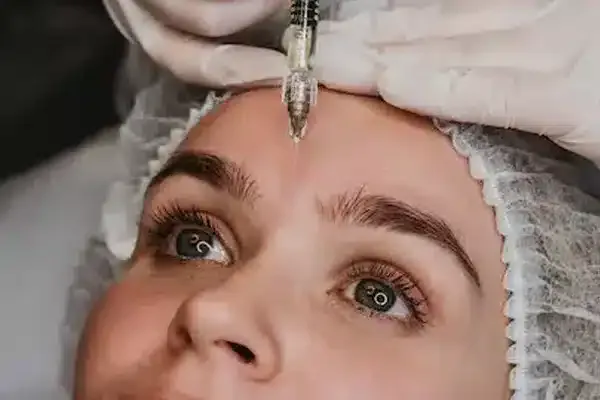
The 5-point injection pattern for the glabella is standardized and looks like this in practice:
- The skin is cleaned with an antiseptic.
- The injector asks you to frown maximally to map the active muscle bellies.
- Marks are placed (or memorized): two points per corrugator and one midline procerus point.
- A fine 30- or 32-gauge needle delivers small aliquots (0.05 to 0.1 mL each) at each marked site.
- Light pressure is applied to minimize bruising. No bandages needed.
The full appointment runs 15 to 20 minutes including consent and post-care instructions. The injection portion itself is about 2 minutes. Pain is mild and brief. Most patients describe a small pinch and a quick burn that resolves within seconds.
When will I see results?
The Botox timeline for the glabellar area is predictable for most patients:
- Days 1 to 2: No visible change. Some patients feel mild tightness or pressure at the injection sites.
- Days 3 to 5: First softening of the 11 lines. You will notice that frowning produces less of a crease.
- Days 10 to 14: Peak result. The 11 lines are minimized or absent at rest; dynamic movement is significantly reduced. This is when injectors assess whether a touch-up is needed.
- Weeks 4 to 12: Full effect plateau.
- Weeks 13 to 16: Most patients return for retreatment.
Static lines, the creases that remain at rest after years of dynamic wrinkling, soften gradually with repeated treatment but may not disappear entirely. Deep, etched static lines often need adjunctive treatment with microneedling, fractional laser, or carefully placed filler to fully smooth. For more on long-term Botox results, see our how long does Botox last guide.
What are the side effects of glabellar Botox?
Side effects are typically mild and short-lived:
- Headache in the first 24 to 48 hours. The most common reaction; usually responds to acetaminophen.
- Bruising at injection sites. More common in patients on aspirin, fish oil, or alcohol the night before. Resolves in 3 to 7 days.
- Brow heaviness if the dose was placed too low or migrated. Transient and usually resolves within 2 to 4 weeks. More common when forehead and glabella are treated together with mismatched dosing.
- Eyelid ptosis (drooping) if the toxin diffuses to the levator palpebrae superioris muscle. Uncommon (less than 3% in pivotal trials). Lasts 4 to 6 weeks. Apraclonidine eye drops can partially compensate while waiting for the toxin to wear off.
- Asymmetry. One side may respond faster than the other. Easily corrected with a small touch-up at the 2-week mark.
Serious adverse events are rare. Patients with myasthenia gravis, Lambert-Eaton syndrome, or known hypersensitivity to botulinum toxin should not receive glabellar Botox.
What does glabellar Botox cost in Orange County?
Pricing in Orange County in 2026 typically runs:
- $12 to $16 per unit for Botox
- $10 to $14 per unit for Xeomin
- $4 to $6 per unit for Dysport (Dysport uses approximately 2.5 to 3 units per 1 unit of Botox, so per-area cost is similar)
- $7 to $10 per unit for Daxxify (typically 40 units for glabellar, so per-area cost runs $280 to $400 or more)
For a standard 20-unit Botox glabellar treatment, total cost lands around $240 to $320 per session. With 3 treatments per year, plan for $720 to $960 annually. Daxxify at the same area runs $560 to $850 per session but is typically dosed every 6 months instead of every 3 to 4 months. For the full cost comparison, see our Botox vs Daxxify guide.
Who is a good candidate for 11-line Botox?
- Adults 21 and older (FDA-approved age range)
- Patients with moderate-to-severe glabellar lines visible at rest or with maximum frown
- Patients without active skin infection at the injection site
- Patients not pregnant or breastfeeding (safety data is limited; most providers defer treatment)
- Patients without neuromuscular disease (myasthenia gravis, Lambert-Eaton, ALS)
- Patients with realistic expectations about static line softening (the deeper the line, the more sessions needed to soften)
What if I’m new to Botox and just want to start with the 11s?
This is the most common first-treatment request, and it is a reasonable starting point. The glabellar area is well-studied, has a clear FDA-approved dose, and produces a visible result without dramatically changing your overall facial expression. Many patients prefer to do the 11s alone for their first treatment so they can see how their face responds before adding forehead, crow’s feet, or other areas.
One caveat: treating the glabella in isolation in patients with strong forehead muscle activity can produce a temporary “frozen 11s with active forehead” appearance. If your forehead is also active, your injector may suggest a small forehead dose at the same visit for balance. For prevention-minded younger patients, our preventative Botox in your 20s guide covers when starting earlier makes sense.
FAQ
How many units of Botox for the 11 lines do I need?
The FDA-approved dose is 20 units. Most injectors use 20 to 25 units for women and 25 to 30 units for men, adjusted for muscle strength. First-time patients are often started at the lower end with the option to add at a 2-week follow-up.
Does treating the 11 lines change how my face looks overall?
Most patients describe looking “less tired” or “less angry” rather than looking different. The 11 lines often communicate fatigue or irritation even when you are relaxed; softening them produces a more neutral resting expression without altering your features.
Can I still frown after Botox?
You can still convey expression, the muscles are weakened, not paralyzed at standard doses. The full crease no longer forms, but your brows still move and you can still show concentration or displeasure with the rest of your face.
How long does Botox for the 11 lines last?
Typically 3 to 4 months. Some patients see effect closer to 14 to 16 weeks with consistent retreatment over time. For a longer-lasting alternative, Daxxify is FDA-approved for glabellar lines with a median duration of about 6 months in trials.
Will my 11 lines come back worse if I stop Botox?
No. When Botox wears off, your muscles return to their baseline strength and the lines return to whatever they would have been at that point in your life. They do not “rebound” worse than untreated. The skin under treatment may actually look slightly better long-term because it was creased less often during the treatment period.
What if I have deep static 11 lines, not just dynamic ones?
Botox alone may not fully smooth deep etched lines. Adjunctive treatments, microneedling with PRP, fractional laser resurfacing, or carefully placed dermal filler, are options to discuss with your injector. The combination usually delivers a better result than either alone.
How to get started
The 11 lines are the most predictable starting point for cosmetic Botox. A 15-minute consultation covers your goals, prior treatment history, muscle strength assessment, and dose planning. If you decide to proceed, the same visit usually accommodates treatment. Plan to avoid alcohol the night before, skip fish oil for 2 to 3 days, and arrive without heavy makeup over the brow area.
Talk to a clinician at OC Weight Loss and Medspa
Glabellar Botox is one of the most common treatments at our clinic. Visit our Botox service page for pricing and to book, or schedule a consultation to map out the right dose and product for your face.
Book a free consultation
Related treatments at our Mission Viejo clinic
Not sure which treatment fits? These are the related services our clinicians most often discuss at a consultation.
- Botox Injections in Orange County CA – Quick & Convenient, Discover Botox injections to smooth fine lines, reduce wrinkles, and achieve a youthful, refreshed look with safe, non-surgical treatments.
- Dysport in Orange County – Get Results in Days, Searching for the best Dysport near me?
- Daxxify Injections Near Orange County - No Downtime, Looking for Daxxify injections near me?
References
- Efficacy and Safety of Botulinum Toxin Type A for Treatment of Glabellar Lines: A Network Meta-Analysis of Randomized Controlled Trials — Aesthetic Plast Surg 2023, via PubMed
- Efficacy and Safety of Botulinum Toxin Type A in the Treatment of Glabellar Lines: A Meta-Analysis of Randomized, Placebo-Controlled, Double-Blind Trials — Plast Reconstr Surg 2015, via PubMed
- Efficacy and safety of Botulinum toxin A for improving esthetics in facial complex: A systematic review — Braz Dent J 2021, via PubMed