Quick answer: Botox and Daxxify are both botulinum toxin type A injectables that smooth wrinkles by relaxing the muscles underneath. Botox typically lasts 3 to 4 months. Daxxify uses a novel peptide stabilizer instead of human serum albumin and lasted a median of about 6 months for glabellar lines in its pivotal trials. Daxxify usually costs $400 to $600 more per treatment area, so it tends to fit patients who hate frequent visits, travel often, or want longer stretches between touch-ups.
If you have spent any time researching neurotoxins, you already know Botox. Daxxify is the newer name on the menu, and it shows up in almost every “longer-lasting Botox” conversation patients bring to consultations. The two products are close cousins but they are not interchangeable. The most useful comparison goes beyond marketing claims and looks at how they work, how long they actually last in trials, how much more Daxxify costs in practice, and which patient profile each one tends to suit.
This guide walks through both products side by side so you can have a real conversation with your injector. For background on the broader category, see our neurotoxins guide, and for two other common matchups read Botox vs Dysport and our breakdown of Botox for forehead lines.
What are Botox and Daxxify?
Botox Cosmetic (onabotulinumtoxinA) is the original, FDA-approved cosmetic botulinum toxin type A. It has been used cosmetically since the FDA approved it for glabellar lines in 2002. The same molecule, in different doses, is also approved for migraine, hyperhidrosis, spasticity, and several other medical uses.
Daxxify (daxibotulinumtoxinA-lanm) is the newest cosmetic neurotoxin in the U.S. The FDA approved it for moderate-to-severe glabellar lines in September 2022. Like Botox, it is a botulinum toxin type A, but the molecule is paired with a proprietary peptide excipient instead of the human serum albumin (HSA) used to stabilize Botox. That peptide is the structural reason patients hear about a longer duration of effect.
How does each one work?
Both Botox and Daxxify do the same biological job: they block the release of acetylcholine at the neuromuscular junction, which keeps the targeted muscle from contracting fully. When the muscle relaxes, the overlying skin stops creasing, and the dynamic wrinkle softens. New collagen also accumulates more slowly over time because the skin is not being folded as often.
The mechanism is identical. What changes between the two products is the formulation around the active toxin. Botox uses HSA and sodium chloride. Daxxify replaces HSA with a positively charged peptide (RTP004) that binds the toxin during manufacturing and is thought to help it stay anchored at the injection site for longer. That difference in the supporting “shell” is what the FDA-approved label and the SAKURA pivotal trials describe as driving the extended duration.
How long does each one last?
Real-world ranges, not absolute numbers, are the honest answer here.
- Botox: Most patients see effect onset in 3 to 5 days, peak result around 2 weeks, and return of muscle movement at 3 to 4 months for the forehead, glabella, and crow’s feet.
- Daxxify: Onset is comparable (within a few days), peak around 2 weeks, and median duration of effect for glabellar lines reported as approximately 6 months in the SAKURA trials, with some patients maintaining results out to 9 months (Daxxify FDA prescribing information, 2022).
“Median” matters. Half of trial patients saw effects shorter than 6 months, and half saw longer. In clinical practice, expressive faces and high-metabolism patients often see results closer to 4 to 5 months with Daxxify and closer to 2.5 to 3 months with Botox. A small subset of patients does not respond as strongly to one product or the other, which is one reason injectors sometimes rotate brands.
Botox vs Daxxify at a glance
| Factor | Botox | Daxxify |
|---|---|---|
| Stabilizer | Human serum albumin (HSA) | Proprietary peptide excipient instead of HSA |
| Onset and peak | Most patients: onset 3 to 5 days; peak around 2 weeks | Comparable onset (within a few days); peak around 2 weeks |
| How long it lasts | Typically 3 to 4 months | Median about 6 months for glabellar lines in its pivotal trials |
| Typical glabellar dose | 20 units | 40 units — unit potency differs, so counts are not comparable |
| Cost (glabellar area, rough estimates) | $240 to $320 per visit; ~$720 to $960 a year at 3 visits | $280 to $400/visit or $650 to $850 flat; ~$1,300 to $1,700 a year at 2 visits |
| Tends to make sense when | Cost per visit is the dominant constraint | Visit frequency is the dominant constraint |
Who is each one for?
When Botox tends to make sense
- You are new to neurotoxins and want to start with the most established option.
- You prefer smaller, more frequent adjustments rather than committing for 6 months.
- You are sensitive to upfront cost and would rather pay less per visit.
- You have responded well to Botox in the past and have no reason to switch.
- You want the flexibility to fine-tune dose and placement every 3 to 4 months as your face changes.
When Daxxify tends to make sense
- You travel often or have a packed schedule and dislike booking quarterly appointments.
- You have a strong glabellar line history and want fewer “wear-off” weeks between treatments.
- You have, in the past, felt that Botox wore off faster than expected (high metabolism, very active patients).
- You are comfortable with a higher per-treatment price in exchange for fewer visits per year.
- You want or need to avoid HSA in your medications (uncommon but relevant for a small group).
What does the cost difference actually look like over a year?
This is where the math gets practical. Per-area pricing varies widely by region and injector, but the relative cost picture in Orange County in 2026 looks roughly like this:
- Botox, glabellar area, 20 units at $12 to $16 per unit: $240 to $320 per visit. With 3 visits per year, total annual cost lands around $720 to $960.
- Daxxify, glabellar area, 40 units at $7 to $10 per unit (Daxxify is priced per unit at a lower number, but uses more units): $280 to $400 per visit, often quoted as a $650 to $850 flat per-area price. With 2 visits per year, total annual cost lands around $1,300 to $1,700.
Annual cost is not always lower with the longer-lasting product. The per-visit price is higher, and the per-year price often is too. What Daxxify saves is time, not money. That distinction is the single most useful question to bring into a consultation: are you optimizing for fewer visits, or for lower annual spend?
What does the research show?
The pivotal evidence base for Daxxify comes from the SAKURA-1 and SAKURA-2 randomized trials, which evaluated 40 units for moderate-to-severe glabellar lines. Approximately 74% of treated patients in pooled SAKURA data showed a 2-point or greater improvement on the validated Investigator Global Assessment for Frown Lines at 4 weeks, with median duration of effect at approximately 24 weeks (Daxxify FDA label, 2022).
For Botox Cosmetic, decades of randomized data and post-market surveillance support a 3 to 4 month duration for moderate-to-severe glabellar lines and a strong long-term safety profile. The FDA prescribing information remains the cleanest source for dosing, contraindications, and adverse-event reporting (Botox Cosmetic FDA label).
Head-to-head, blinded randomized trials directly comparing Daxxify against Botox for cosmetic glabellar treatment are limited in the published literature as of early 2026. Most direct comparisons are observational or rely on indirect cross-trial comparison, which is a real limitation when claims of “twice as long” get repeated in marketing. The honest framing: Daxxify clearly lasts longer than Botox in its own pivotal trials, but the exact multiplier varies patient to patient.
What are the side effects of each?
The reported side-effect profiles are similar, which is expected for two products in the same drug class. The most common reactions for both are:
- Headache for 24 to 48 hours after treatment
- Injection-site bruising, tenderness, or small bumps that resolve in 15 to 30 minutes
- Brow heaviness or eyelid ptosis if the toxin migrates or is placed too low, rare with experienced injectors
- Asymmetry that responds to a small touch-up at 2 weeks
Serious adverse events (distant spread, true allergic reaction) are rare for both products. Patients with neuromuscular disorders such as myasthenia gravis or Lambert-Eaton syndrome should not receive either neurotoxin without specialist guidance.
Can you switch from Botox to Daxxify (or back)?
Yes. There is no required washout period between products as long as you wait until the prior product has fully worn off, or until at least 12 weeks have passed and you and your injector agree the response is incomplete. Switching is most often done for one of three reasons: a patient wants to try the longer duration of Daxxify, a patient who previously felt Botox lasted only 8 to 10 weeks wants to see if Daxxify performs differently, or a patient with suspected antibody resistance to onabotulinumtoxinA wants to trial a different toxin (in that scenario, Xeomin is usually the first switch, more on that in our Botox vs Xeomin guide once it publishes).
How does the injection appointment differ?
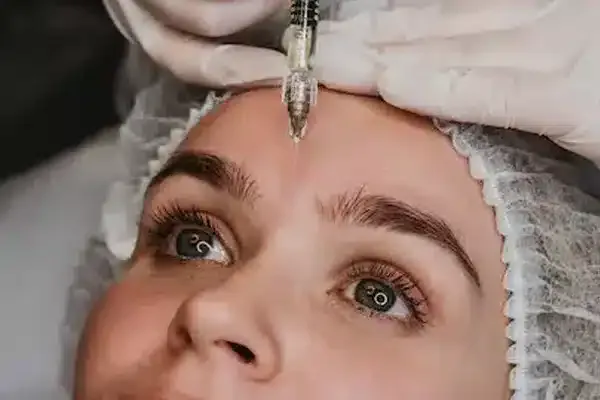
From the patient’s chair, the visits feel nearly identical. The skin is cleaned, the injector marks injection points, and a fine 30- or 32-gauge needle delivers small aliquots into the targeted muscles. The total appointment for a glabellar-only treatment runs about 15 to 20 minutes, including consent and post-care instructions.
The injector handles the dosing math. Because Daxxify and Botox use different unit potency, the “number of units” written on your chart will not be the same, Daxxify typically uses 40 units for glabellar where Botox uses 20. Do not compare unit counts across products; only compare them within the same product over time.
How to choose: a short decision framework
- If cost per visit is the dominant constraint: Start with Botox.
- If visit frequency is the dominant constraint: Start with Daxxify.
- If you have had Botox before and felt it wore off in under 10 weeks consistently: Trial Daxxify or have a real conversation about possible under-dosing first.
- If you are brand new to neurotoxins and unsure how your face will respond: Start with Botox. It is easier to fine-tune at the 3-month mark.
- If you want maximum data history behind the product: Botox has 20+ years of cosmetic surveillance.
FAQ
Is Daxxify twice as strong as Botox?
No. Daxxify is not stronger than Botox per dose. It is dosed differently. The glabellar label dose is 40 units of Daxxify versus 20 units of Botox, and the per-unit potency is not the same. What Daxxify is, in its own trials, is longer-lasting, with a median duration of about 6 months.
Will Daxxify look different from Botox once it kicks in?
The relaxed, smoothed look at peak effect is comparable. If your injector dosed appropriately for the area, you should not see a “different” face from one product versus the other. The differences show up later, in how slowly the result fades.
If Daxxify lasts 6 months, why doesn’t everyone switch?
Three reasons. First, it costs more per visit. Second, some patients prefer the flexibility of a 3-month touch-up to fine-tune dose and placement. Third, real-world duration varies, for very expressive faces or higher-metabolism patients, the gap between 4 months (Botox) and 5 months (Daxxify) is smaller than the trial data suggests.
Is Daxxify safer than Botox?
Both products have similar safety profiles in their FDA prescribing information. Daxxify has less long-term post-market data simply because it has been available since 2022, while Botox Cosmetic has been on the cosmetic market since 2002. Neither is meaningfully “safer” than the other for an otherwise healthy adult.
Can I get Daxxify for areas other than the glabellar lines?
The FDA approval is for moderate-to-severe glabellar lines. Some injectors use Daxxify off-label for forehead lines, crow’s feet, or masseter treatment, but pivotal trial data outside the glabella is more limited. Off-label use is legal and common in aesthetics, ask your injector about their experience in the specific area you are considering.
How long should I wait before my next treatment with either product?
For Botox, most patients retreat at 3 to 4 months. For Daxxify, retreatment is generally 6 months for glabellar lines based on trial design. Retreating too early, with either product, can raise the theoretical risk of antibody formation. Most injectors will not retreat within 8 to 10 weeks of a recent dose unless there is a clear under-correction.
Does insurance cover Botox or Daxxify cosmetically?
No. Cosmetic use is paid out of pocket. Botox has separate medical indications (chronic migraine, hyperhidrosis, cervical dystonia) that may be insurance-covered with prior authorization; Daxxify currently does not have those medical indications.
How to get started
Most patients make this decision easier with a 20-minute consult than with another hour of online reading. The honest decision points are: how often are you willing to come in, what is your annual budget, and how has your face responded to neurotoxins in the past. Bring a recent selfie at full frown if you have one. It helps the injector estimate dose for either product.
Talk to a clinician at OC Weight Loss and Medspa
If you want a side-by-side recommendation based on your facial anatomy, prior treatment history, and visit-frequency preferences, our injectors carry both Botox and Daxxify and can walk you through the trade-offs in person. See our full Botox service page for pricing and provider bios.
Book a free consultation
Related treatments at our Mission Viejo clinic
Not sure which treatment fits? These are the related services our clinicians most often discuss at a consultation.
- Botox Injections in Orange County CA – Quick & Convenient, Discover Botox injections to smooth fine lines, reduce wrinkles, and achieve a youthful, refreshed look with safe, non-surgical treatments.
- Dysport in Orange County – Get Results in Days, Searching for the best Dysport near me?
- Daxxify Injections Near Orange County - No Downtime, Looking for Daxxify injections near me?
References
- Efficacy and Safety of Botulinum Toxin Type A for Treatment of Glabellar Lines: A Network Meta-Analysis of Randomized Controlled Trials — Aesthetic Plast Surg 2023, via PubMed
- Efficacy and Safety of Botulinum Toxin Type A in the Treatment of Glabellar Lines: A Meta-Analysis of Randomized, Placebo-Controlled, Double-Blind Trials — Plast Reconstr Surg 2015, via PubMed
- Efficacy and safety of Botulinum toxin A for improving esthetics in facial complex: A systematic review — Braz Dent J 2021, via PubMed