
Quick summary: California Senate Bill 418 would have required health insurers and pharmacies to dispense up to a 12-month supply of FDA-approved prescription hormone therapy at once. The bill passed the Legislature but was vetoed by Governor Newsom on October 13, 2025. Current refill rules, generally 90 days under existing law, remain unchanged. Patients on HRT in California can still take practical steps to reduce refill gaps, and clinical options like hormone pellet therapy may reduce pharmacy visits for appropriate candidates.
Refill timing can shape health. When a prescription runs in 30- or 90-day blocks, a routine medication can turn into a recurring scramble with the pharmacy, your clinician’s office, and your insurer. Many Californians on hormone replacement therapy know that rhythm well.
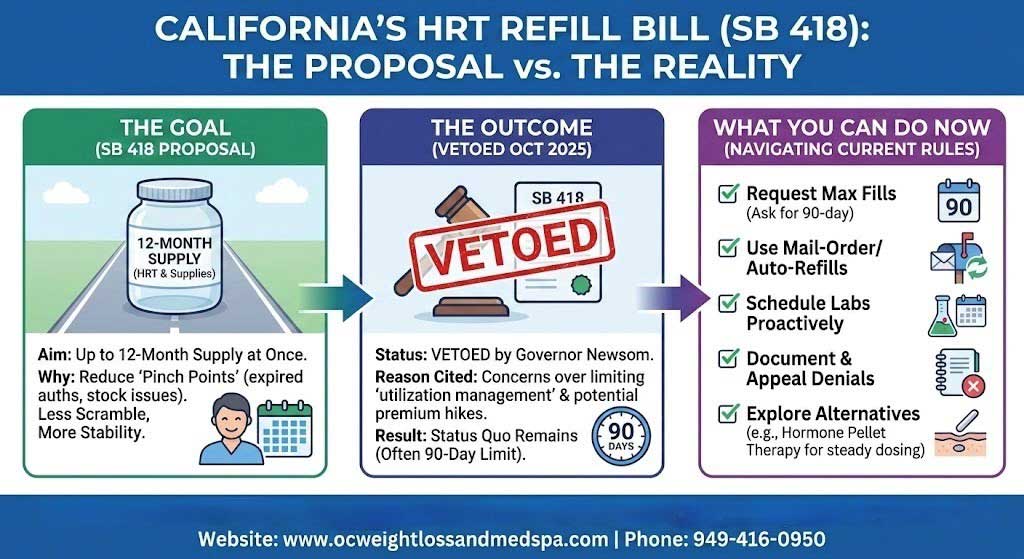
SB 418 (Sen. Caroline Menjivar) was written to reduce those pinch points by letting patients receive a much longer supply of prescription hormone therapy at one time. The bill passed the Legislature in 2025, reached Governor Gavin Newsom, and was vetoed on October 13, 2025. The refill rules did not change. What did change is the public focus on why refills are so often smaller than patients and prescribers would prefer.
What SB 418 proposed
The bill targeted two places where delays tend to show up.
- Insurance coverage. SB 418 would have required many health plans and insurers that offer outpatient drug benefits to cover up to a 12-month supply of FDA-approved prescription hormone therapy (and self-administration supplies) when prescribed by an in-network provider and dispensed at one time.
- Pharmacy dispensing. It also would have required pharmacists to dispense up to a 12-month supply at a patient’s request when the prescription allowed periodic refills, with narrow exceptions (patient preference, prescriber instructions, or a temporary shortage-related limit).
State analyses described current California practice as generally limiting dispensing of prescription hormone therapy to 90 days. SB 418 defined the covered category broadly, but excluded certain drugs, including controlled substances and therapies requiring refrigeration.
Why a longer supply mattered
A longer fill is not just about convenience. It reduces the number of times the system can fail. Every refill cycle is a chance for a lab order to be missing, for a prior authorization to expire, for a shipment to run late, or for a pharmacy to be out of stock that week.
SB 418 also addressed what many patients already say: access includes the supplies needed to use the medication, not just the medication itself.
What Californians on HRT can do now
If you are on HRT and refill delays are becoming a pattern, these practical steps often help reduce gaps:
- Ask your prescriber to write for the largest quantity your plan typically covers for maintenance medications (many plans allow 90 days).
- Use mail-order if it fits your timing; automatic refills can be steadier than last-minute counter trips.
- Keep notes on denial codes and dates so you can request a coverage review quickly.
- Schedule labs and follow-ups before you are down to your last doses.
It also helps to ask your pharmacy a few specific questions: Can they set up automatic refills, text alerts, or a consistent pickup date? Does your plan allow 90-day fills at retail, or only by mail?
Small workflow changes can prevent the gap that shows up right before a weekend or a trip.
Also read: How Effective Is HRT in Alleviating Hot Flashes During Menopause
Some patients explore options that reduce how often they deal with retail pharmacy refills. In Orange County, that includes hormone pellet therapy services for appropriate candidates, which can provide steady dosing over time under clinical supervision.
This article is for general information only and is not medical advice. Talk with a licensed clinician about your individual situation.
Frequently Asked Questions
Did SB 418 become California law?
No. It passed the Legislature, but Governor Newsom vetoed it on October 13, 2025, so it did not take effect and did not change California refill rules.
What would SB 418 have changed about HRT refills?
It would have required coverage and dispensing toward a 12-month supply of FDA-approved prescription hormone therapy at one fill, when a valid prescription included refills, with limited stated exceptions. It also aimed to cover self-administration supplies at the same time.
What is the HRT refill limit in California right now?
Analyses tied to SB 418 described a general 90-day limit for dispensing prescription hormone therapy under existing law, though individual insurers and pharmacies may set shorter intervals or additional requirements. Ask your plan directly for its current pharmacy benefit rules.
Why did the Governor veto SB 418?
He cited concerns about restricting insurers’ utilization management tools and noted the change could raise premiums by limiting a common cost-control mechanism, even though the goal was better patient access.
Could a similar HRT supply bill pass in the future?
Possibly. SB 418’s legislative progress reflected strong interest in longer dispensing periods. Future proposals may use a narrower approach or address cost, fraud, and oversight concerns that contributed to the veto.
Talk with a clinician about your HRT options
At OC Weight Loss & Med Spa in Mission Viejo, our team reviews symptoms, labs, and hormone therapy options with each patient individually. If you want a plan that fits real life and reduces refill friction, a free consultation is a good starting point. Individual results vary.
Book a free consultation
Related treatments at our Mission Viejo clinic
Not sure which treatment fits? These are the related services our clinicians most often discuss at a consultation.
- Hormone Replacement Therapy Orange County, Explore hormone replacement therapy to restore balance, boost energy, and improve overall wellness with safe, personalized treatment options.
- Peptide Therapy in Orange County, Clinician-supervised peptide therapy in Mission Viejo: Ipamorelin, NAD+, GLOW Blend, BPC-157.
- Medical Weight Loss Orange County, Clinician-supervised medical weight loss in Mission Viejo, CA.
What to do if you hit a delay anyway
A change in the rules does not always translate immediately into a change in what happens at the pharmacy counter, and knowing where a hold-up sits makes it considerably easier to resolve.
Delays generally originate in one of three places. The prescriber may not yet have submitted what the plan requires. The plan may be applying a policy that has not been updated. Or the pharmacy may be waiting on an authorization that was approved but not transmitted. These have different fixes, and calling the wrong party wastes time.
The useful first step is to ask the pharmacy specifically what they are waiting for and from whom, and to get that in concrete terms rather than as a general statement that it is pending. With that, you can direct the follow-up accurately.
Keep your own record: dates, who you spoke to and what was said. If a coverage decision is adverse, plans have an appeals process and a timeline attached to it, and prescriber support during an appeal makes a material difference to the outcome.
Where a delay is prolonged, ask your prescriber whether a short bridging supply is appropriate so treatment is not interrupted while the administrative side resolves. This is a matter for your clinician and plan rather than something to manage alone.
References
- Postmenopausal hormone therapy: an Endocrine Society scientific statement — J Clin Endocrinol Metab 2010, via PubMed
- Androgen therapy in women: a reappraisal: an Endocrine Society clinical practice guideline — J Clin Endocrinol Metab 2014, via PubMed