
Quick summary: Starting January 1, 2026, Medi-Cal stopped covering GLP-1 medications prescribed solely for weight loss. Coverage for diabetes indications continues. Adults may still qualify under limited exceptions with prior authorization, and members under 21 may qualify under EPSDT rules. If you received a denial, you have 90 days to request a State Hearing, or 10 days to request continued benefits while the appeal is pending.
GLP-1 medications are now part of routine care for many people managing obesity and related conditions. Medi-Cal beneficiaries should know one hard date: Medi-Cal Rx says that, beginning January 1, 2026, GLP-1 drugs prescribed for “weight loss only” will not be covered, and previously approved prior authorizations are scheduled to end on December 31, 2025.
What is changing, and what is not
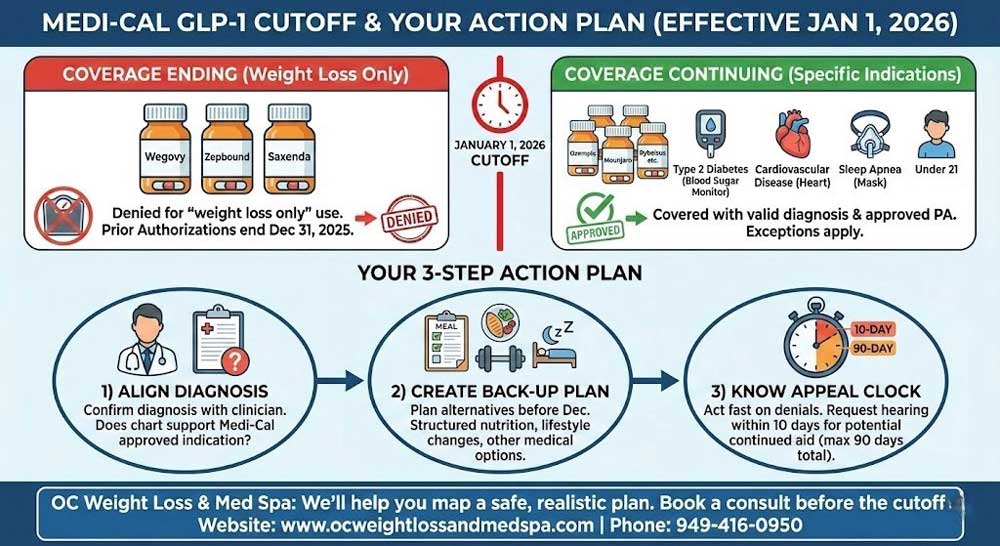
- Medi-Cal Rx’s member notice names Wegovy, Zepbound, and Saxenda and states that coverage ends after January 1, 2026 when the only purpose is weight loss.
- These drugs will be removed from the Medi-Cal Rx Contract Drugs List for weight-loss indications, meaning claims will deny, with limited exceptions that may be considered under prior authorization, such as Wegovy for certain cardiovascular disease or MASH uses and Zepbound for obstructive sleep apnea (OSA).
- Medi-Cal Rx indicates that drugs such as Ozempic, Rybelsus, Mounjaro, Victoza, Byetta, Bydureon, and Trulicity will continue to be covered for type 2 diabetes when diagnosis requirements are met and an approved request is on file, but they will be denied when prescribed for weight loss only.
- Members younger than 21 may still qualify for weight-loss coverage if a prior authorization request is submitted and approved under federal EPSDT rules.
And adults may still have a path when a non-weight-loss indication fits Medi-Cal Rx guidance, but the prescriber has to request it and document it well.
Why the cutoff is hitting nerves
California’s budget debate has framed these drugs as a major cost driver. CalMatters reported that state leaders considered ending Medi-Cal coverage for popular weight-loss drugs on Jan. 1, 2026 as a savings measure, while clinicians warned about likely weight regain and lost health improvements when treatment stops. Patients feel it more simply: if the refill is denied, progress can stall.
If you have been typing medical weight loss near me into a search bar, use that impulse to line up care that can handle documentation and next-step planning, not just a prescription.
Your 3-step action plan
1) Get the diagnosis aligned with the coverage rules
Meet with the clinician who writes your GLP-1 and confirm what diagnosis is attached to the prescription. Under the new rules, coverage turns on indication. Ask whether your chart clearly supports the diagnosis Medi-Cal will review, and whether a prior authorization will be needed heading into 2026.
2) Create a back-up plan that fits real life
If your GLP-1 use is “weight loss only,” plan for an alternative before late December. That might include structured nutrition support, strength training, sleep and stress work, and other medically appropriate options discussed with your clinician. In Orange County, consistency often matters more than intensity, which is why weightloss in OC tends to succeed when the plan matches schedules, food access, and family routines.
3) Know the appeal clock
Medi-Cal Rx explains that members who receive a Notice of Action denying coverage can request a State Hearing, generally within 90 days. It also notes that members taking GLP-1 drugs on or before January 1, 2026 who request a hearing within 10 days of a denial may be able to keep receiving the drug while the appeal is pending, subject to the notice’s limits. Put those deadlines where you will see them.
Also Read: Thinking of Getting GLP-1 RA? Here’s Why Diet and Exercise Still Matter
Quick timeline
Many patients do better with steady follow-up, labs, and coaching over time. In Orange County, that often means choosing weight loss clinics Orange County that can coordinate medical care and paperwork together.
Frequently Asked Questions
1. Does Medicare cover GLP-1 for weight loss in 2025?
Medicare generally cannot cover drugs used only for weight loss. Some Part D plans may cover Wegovy when prescribed for FDA-approved cardiovascular risk reduction in eligible patients. Coverage varies, so confirm with your Part D plan.
2. What is a GLP-1 plan?
A GLP-1 plan is a clinician-run roadmap: screening, a dosing schedule, nutrition and activity goals, side-effect check-ins, and follow-up labs. It also includes steps like prior authorizations and refill timing.
3. What is the BMI cut off for GLP-1?
For chronic weight management uses on FDA labeling, the typical threshold is BMI 30 or higher, or BMI 27 or higher with at least one weight-related condition such as hypertension or dyslipidemia.
4. Will Medi-Cal still cover GLP-1 drugs for diabetes after Jan. 1, 2026?
Medi-Cal Rx has said several GLP-1 drugs will continue to be covered for type 2 diabetes when diagnosis requirements are met and an approved request is on file.
5. Can Medi-Cal members appeal a GLP-1 denial?
Yes. Medi-Cal Rx explains that members can request a State Hearing within 90 days of a denial notice, and a request within 10 days may allow continued benefits while the appeal is pending.
Schedule a consultation at OC Weight Loss & Med Spa
If your Medi-Cal GLP-1 coverage has ended or you are navigating a denial, the team at OC Weight Loss & Med Spa in Mission Viejo can help you understand your options and build a medically appropriate plan. Our clinicians review your full health picture, not just the prescription, to help you move forward safely. Individual results vary.
Book a free consultation
Related treatments at our Mission Viejo clinic
Not sure which treatment fits? These are the related services our clinicians most often discuss at a consultation.
- GLP-1 Weight Loss Orange County, Explore GLP1 for Weight Loss in Orange County.
- Semaglutide Injections in Orange County, CA, Medically supervised Semaglutide weight loss injections in Mission Viejo, serving Orange County.
- Medical Weight Loss Orange County, Clinician-supervised medical weight loss in Mission Viejo, CA.
What to ask your prescriber if coverage ends
A coverage change is disruptive mainly because it arrives as an administrative fact rather than a clinical plan. The useful response is to convert it back into a clinical conversation, and there are four questions that do most of the work.
First: is there an alternative covered medication appropriate for me? Formularies differ, and a different agent in the same class or a different class entirely may remain available.
Second: if I need to stop, how should that be done? Stopping abruptly and stopping in a planned way produce different experiences, and appetite returning is expected rather than a sign of failure.
Third: what is the plan for maintaining what I have achieved? This is where the eating pattern, protein intake and resistance training built during treatment become the whole strategy rather than the supporting cast.
Fourth: is an appeal or exception worth pursuing in my case, and will you support it? Clinical documentation of why a specific medication is necessary carries weight, and prescribers vary in how readily they offer this rather than in whether they can.
Booking a review before coverage lapses rather than after is worth the appointment. A plan made in advance is a plan; one made afterward is damage control.
References
- Once-Weekly Semaglutide in Adults with Overweight or Obesity — N Engl J Med 2021, via PubMed
- AGA Clinical Practice Guideline on Pharmacological Interventions for Adults With Obesity — Gastroenterology 2022, via PubMed