Bottom line up front: CoolSculpting (cryolipolysis) is a non-surgical fat-reduction treatment that freezes and gradually kills fat cells in pinchable areas, with results showing up over 2–3 months and no downtime. Liposuction is a surgical procedure that suctions out larger volumes of fat in a single operating-room session, with immediate visible volume change and 1–2 weeks of meaningful recovery. CoolSculpting suits patients near their goal weight with localized stubborn fat and good skin elasticity. Liposuction suits patients who want larger-volume removal, more dramatic contouring, or who have already done their part with weight loss and now want the surgeon to finish. Neither replaces weight loss; both are body-contouring tools.
If you have hit a wall with diet and exercise but still have a roll of fat that will not move, you are not alone, and you are the exact patient for whom body contouring exists. The two best-known options are CoolSculpting and liposuction. They are often pitched as competitors, but they are really two different tools for two different problems. This guide breaks down how each one works, what results look like, what they cost, who they are for, and how to decide between them. For a broader treatment overview, see our body contouring guide.
What is CoolSculpting?
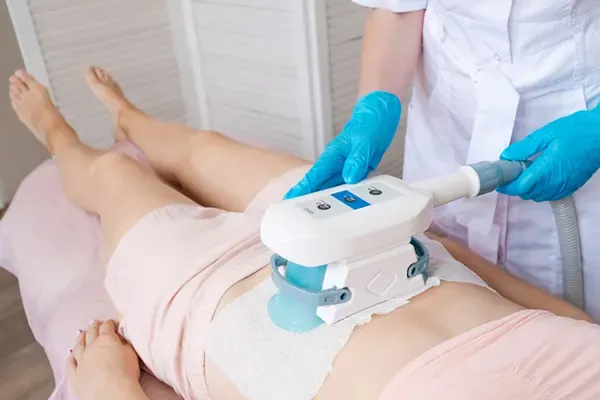
CoolSculpting is the best-known brand of cryolipolysis, controlled cooling of subcutaneous fat to a temperature that kills fat cells without damaging the overlying skin. An applicator is suctioned onto a pinchable area for 35–60 minutes per cycle. The cooled fat cells (adipocytes) undergo apoptosis and are gradually cleared by the lymphatic system over 8–16 weeks. The FDA first cleared the device for flank treatment in 2010 and has since expanded clearance to the abdomen, thighs, submental area (under the chin), back, bra fat, and upper arms.
What is liposuction?
Liposuction is a surgical procedure in which a board-certified plastic surgeon, dermatologic surgeon, or cosmetic surgeon makes small incisions, infiltrates the area with tumescent fluid (a mix of saline, lidocaine, and epinephrine), and then uses a hollow cannula connected to suction to remove fat. Modern variations include traditional suction-assisted lipo (SAL), power-assisted lipo (PAL), ultrasound-assisted lipo (UAL, VASER), and laser-assisted lipo (SmartLipo). The procedure is typically done under local tumescent anesthesia, IV sedation, or general anesthesia depending on volume and patient preference.
CoolSculpting vs liposuction: head-to-head comparison
| Factor | CoolSculpting | Liposuction |
|---|---|---|
| What it is | Non-surgical treatment that freezes and gradually kills fat cells | Surgical procedure that suctions out larger volumes of fat in one OR session |
| Results timeline and downtime | Results show up over 2–3 months; no downtime | Immediate visible volume change; 1–2 weeks of meaningful recovery |
| Who it suits | Patients near goal weight with localized stubborn fat, good skin elasticity | Patients wanting larger-volume removal or more dramatic contouring |
| Do the fat cells come back | Fat cells that are killed do not regenerate | Removed fat cells do not regenerate, but remaining cells can still expand |
| Typical cost | A typical plan lands in the $2,500–$5,000 range | Runs $6,000–$12,000 depending on technique and geography |
How does each one actually work in the body?
CoolSculpting (mechanism)
Subcutaneous fat freezes at a higher temperature than skin and surrounding tissues. The applicator cools to roughly -11°C, holding the targeted fat at a temperature that triggers programmed cell death (apoptosis) without injuring the dermis. Over the next 8–16 weeks, macrophages clear the destroyed fat cells and the body excretes the components through normal lipid metabolism. The fat cells that are killed do not regenerate; the area gets thinner. Areas not treated continue to behave normally, if you gain weight after CoolSculpting, untreated areas will gain disproportionately.
Liposuction (mechanism)
Liposuction physically removes fat tissue. The surgeon infiltrates the area with tumescent fluid, which numbs the tissue, constricts blood vessels, and “inflates” the fat so it can be removed evenly. A cannula is passed through small incisions and connected to suction. With ultrasound-assisted lipo, an ultrasound probe first emulsifies the fat; with laser-assisted lipo, a laser fiber liquefies fat and also delivers heat that can drive mild collagen contraction. The surgeon shapes the result in real time. Like CoolSculpting, the removed fat cells do not regenerate, but remaining cells can still expand if you gain weight.
Who is each treatment for?
You are likely a good CoolSculpting candidate if:
- You are within 10–20 lb of your goal weight
- You have specific pinchable fat areas, love handles, lower belly, inner thighs, bra fat, double chin
- You have good skin elasticity (skin will retract around the smaller volume)
- You cannot or will not take time off work for surgery
- You prefer a no-needle, no-incision approach
- You understand results take 2–3 months and may need a second cycle to the same area
You are likely a better liposuction candidate if:
- You want larger-volume fat reduction (more than one CoolSculpting course would achieve)
- You want multiple body areas addressed in one session
- You want immediate, dramatic contouring
- You have good skin tone, or you are open to combining lipo with a skin-tightening procedure if not
- You can take 1–2 weeks off work and wear a compression garment
- You are medically cleared for surgery and anesthesia
Neither is right if you are using it as a weight-loss tool. CoolSculpting and liposuction are body-contouring procedures. They remove inches in specific areas; they do not meaningfully change the scale. If your primary goal is weight loss, that conversation belongs with a medical weight loss program, GLP-1 therapy, structured nutrition, behavior change, first, and contouring after.
Results: what to actually expect
CoolSculpting clinical studies consistently report 20–25% reduction in subcutaneous fat thickness in the treated area per cycle, measured by caliper or ultrasound. Most patients need one to three cycles per area to reach a result they consider visible in clothing. The visible effect lags the treatment by 4–12 weeks, which is the single most common source of disappointment, patients walk out of the appointment looking the same and assume nothing happened. Photos at 0, 8, and 16 weeks tell the story.
Liposuction results are visible the day you leave the OR, and then they get worse before they get better. Swelling peaks at 48–72 hours, then resolves over the next 6–12 weeks. The final contour is usually clear at 3 months and continues to refine through 6 months. Patients describe lipo recovery as bruised and sore rather than sharply painful; the bigger ask is the compression garment, which is worn most of the day for 2–4 weeks and then nights only for another few weeks.
Risks and side effects
CoolSculpting risks
Most patients experience temporary numbness, redness, mild bruising, and a deep ache in the treated area that resolves over 1–2 weeks. A small number develop late-onset pain at week 1–2, which is also self-limited. The most-discussed rare complication is paradoxical adipose hyperplasia (PAH), in which the treated area becomes larger rather than smaller, requiring surgical correction. Reported incidence is approximately 0.05–0.4% per cycle, more common in men and in larger applicator sizes.
Liposuction risks
As a surgical procedure, liposuction carries the standard surgical risks: bleeding, infection, anesthesia reaction, venous thromboembolism (rare with appropriate prophylaxis), and lidocaine toxicity if tumescent volumes are not monitored carefully. Aesthetic risks include contour irregularities, asymmetry, seroma, persistent swelling, and skin laxity if too much fat is removed without addressing the skin envelope. Risk increases sharply with the number of areas treated in a single session and with total fat volume removed, which is why the ASPS recommends specific volume limits and additional precautions for large-volume cases.
Cost comparison and value
Per-area, CoolSculpting is generally cheaper than liposuction. A typical CoolSculpting plan, say, two applicator cycles to the lower abdomen plus two to the flanks, lands in the $2,500–$5,000 range. A typical full-abdomen and flank liposuction runs $6,000–$12,000 depending on technique and geography. But cost per cubic centimeter of fat removed often favors liposuction once the patient needs more than one CoolSculpting course.
The real value question is not “which is cheaper per session?”. It is “which one gets you to a result you are satisfied with, given your area, volume, and tolerance for downtime?” For 20 patients we see, roughly:
- 12 are good CoolSculpting candidates and we treat with CoolSculpting
- 5 are better liposuction candidates and we refer to a board-certified surgical colleague
- 3 are not yet ready for either and we start with medical weight loss (GLP-1 program or structured nutrition)
FAQ: CoolSculpting vs liposuction
Does CoolSculpting work as well as liposuction?
For small to moderate pinchable areas, results from a well-planned CoolSculpting course can rival liposuction in patient satisfaction, without anesthesia or surgical downtime. For larger volumes or multiple areas at once, liposuction is more efficient and produces more dramatic results in a single session.
Is CoolSculpting permanent?
The fat cells destroyed by cryolipolysis do not regenerate. In that sense, results are permanent. However, remaining fat cells can still grow if you gain weight, and untreated areas can disproportionately enlarge. Maintaining results requires weight stability.
Can I combine CoolSculpting with liposuction?
Yes, a common sequencing is liposuction for a primary area (e.g., abdomen and flanks) followed by CoolSculpting for smaller secondary areas (inner thighs, bra fat). Most surgeons recommend waiting 3–6 months after liposuction before adding CoolSculpting nearby.
Does CoolSculpting cause loose skin?
Rarely. Because fat is reduced gradually over 2–3 months, the skin generally has time to adapt. Patients with pre-existing skin laxity may not see meaningful improvement and may benefit more from a combination of fat reduction plus a skin-tightening modality.
Is one safer than the other?
Non-surgical CoolSculpting has a meaningfully lower complication profile than any surgical procedure simply because it avoids anesthesia, incisions, and surgical recovery. That does not make CoolSculpting “risk-free”, paradoxical adipose hyperplasia, while rare, is a real complication. The relevant comparison is not “safe vs unsafe” but “which risk profile fits this patient’s goals.”
How long does each procedure take?
A CoolSculpting appointment with two applicators back-to-back is typically 1.5–2 hours, with no recovery time. Liposuction is 1–4 hours in the operating room depending on areas, plus 1–2 weeks of meaningful recovery and a full 3–6 months to final contour.
Will insurance cover either?
No. Both are considered cosmetic procedures and are not covered by US insurance. Most clinics offer cash, financing (CareCredit, Cherry, Affirm), or HSA/FSA payment when applicable.
How OC Weight Loss and Medspa approaches body contouring
We perform CoolSculpting in our Mission Viejo clinic with a treatment plan that includes pre-treatment photos, applicator selection mapped to the patient’s anatomy, and a 12-week follow-up visit to assess results before recommending a second cycle. If your goals are better served by liposuction, we will tell you and refer to a board-certified surgical colleague rather than over-promise non-surgical results. For details on the procedure in our area, see CoolSculpting in Mission Viejo.
Talk to a clinician at OC Weight Loss and Medspa
The honest answer about CoolSculpting vs liposuction takes ten minutes of conversation and a quick pinch test. Learn more about CoolSculpting at OC Weight Loss and Medspa or call +1 949-416-0950 to book a free consultation.
Book a free consultation
Related treatments at our Mission Viejo clinic
Not sure which treatment fits? These are the related services our clinicians most often discuss at a consultation.
- CoolSculpting in Orange County, Get CoolSculpting at OC Weight Loss Medspa to eliminate stubborn fat safely.
- Body Contouring Experts, Shape your body with Body Contouring at OC Weight Loss and Medspa.
- CoolSculpting Fat Removal, At OC Weight Loss Medspa, get CoolSculpting fat removal to target stubborn fat safely.
References
- The Safety and Efficacy of Cryolipolysis: A Systematic Review of Available Literature — Aesthet Surg J 2015, via PubMed
- Cryolipolysis and associated health outcomes, adverse events, and satisfaction: A systematic review and meta-analysis — Obes Rev 2025, via PubMed
- Cryolipolysis for fat reduction and body contouring: safety and efficacy of current treatment paradigms — Plast Reconstr Surg 2015, via PubMed