
Bottom line first: For early-to-moderate androgenetic alopecia, minoxidil is the cheaper, evidence-rich first move ($30/month, decades of data, modest hair-count gain). PRP is the higher-cost in-office option ($400–$800/session, three to four sessions, then maintenance) with growing meta-analytic support for hair density and thickness. Most clinicians who treat hair loss don’t pick one, they combine them. PRP without a topical maintenance plan tends to regress, and minoxidil alone plateaus.
What are PRP and minoxidil, really?
Both treatments target the same underlying problem, androgenetic alopecia, the pattern hair-thinning driven by genetics and dihydrotestosterone (DHT) sensitivity at the follicle, but they attack it from different mechanical angles.
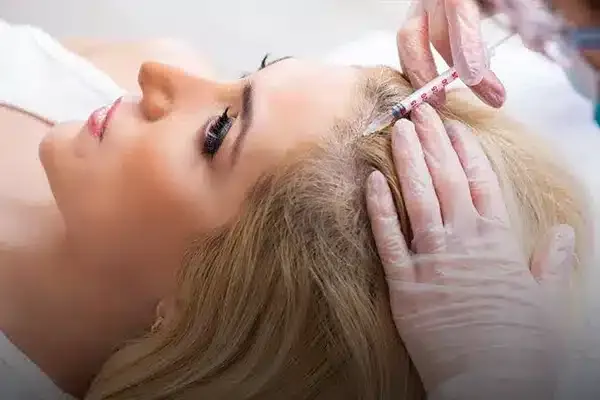
Platelet-rich plasma (PRP) is your own blood, drawn, centrifuged to concentrate the platelet fraction, then injected into the scalp at the level of the follicle. The concentrated platelets release growth factors (PDGF, VEGF, EGF, IGF-1) that stimulate dormant follicles and lengthen the anagen (growth) phase of the hair cycle. For a fuller mechanism walk-through, see our PRP therapy guide.
Minoxidil is a topical vasodilator (originally developed as an oral antihypertensive) that prolongs the anagen phase by mechanisms still being mapped, likely a combination of increased follicular perfusion, ATP-channel opening on the dermal papilla, and prostaglandin signaling. It is available over the counter as a 2% or 5% topical and increasingly prescribed off-label as low-dose oral minoxidil.
PRP vs minoxidil at a glance
| Factor | PRP | Minoxidil |
|---|---|---|
| What it is | Your own blood, centrifuged to concentrate platelets, then injected into the scalp | A topical vasodilator; over the counter as a 2% or 5% topical |
| How it works | Growth-factor stimulation — a periodic pulse delivered by injection | Vasodilation — maintains follicular signaling between sessions |
| Evidence | Growing meta-analytic support for hair density and thickness | Decades of data; a modest hair-count gain |
| Cost and sessions | $400–$800 per session × 3–4 initial sessions, then maintenance every 6–12 months | ~$30/month over the counter for the 5% topical |
| Side effects | Injection-site soreness for 24–48 hours; mild tenderness, transient swelling | Initial shedding at weeks 4–8; scalp irritation, dryness, flaking |
| Best for | Adding a second mechanism after 12+ months of minoxidil, or poor tolerance of it | The lowest-friction first move; see what your follicles do at 4–6 months |
How does each one work mechanically?
What does the evidence show for each?
PRP, evidence summary
The PRP evidence base has matured rapidly. A 2019 meta-analysis pooling 19 studies and 460 patients found PRP produced a statistically significant increase in hair density compared with placebo in androgenetic alopecia, with hair count and thickness improvements documented at follow-up periods between 3 and 12 months (Gupta & Carviel, 2019).
Limitations to flag: protocols are not standardized across studies (centrifuge type, platelet concentration, injection depth, activation method, and session spacing all vary), follow-up is typically short, and the magnitude of effect is modest, measured in hair counts per cm², not the kind of restoration you would associate with a transplant.
Minoxidil, evidence summary
Minoxidil has decades of trials. The 5% topical formulation produces a modest, statistically significant increase in non-vellus hair count over placebo at 48 weeks in both men and women, with the typical responder gaining a measurable but not transformative hair-count improvement. Low-dose oral minoxidil (0.25–2.5 mg) has emerged as a useful option for patients who can’t tolerate the topical, with growing efficacy data in observational series.
The most consistent finding across minoxidil trials: it slows progression as much as it grows hair. Patients who start earlier, when there is still miniaturized hair to rescue, do dramatically better than patients who start late.
Who is a candidate for which?
PRP is best for:
- Early-to-moderate androgenetic alopecia (Norwood 2–4 for men, Ludwig I–II for women). There has to be viable follicle to stimulate
- Patients who tolerate minoxidil poorly or want to avoid it
- Patients planning a hair transplant, PRP is often layered for graft survival
- Diffuse thinning patients (often women) where the goal is density, not a new hairline
PRP does not regrow hair from areas that are slick-bald, once the follicle is gone, no injection brings it back. See does PRP work for hair loss? for candidacy details.
Minoxidil is best for:
- First-line therapy for any patient with early androgenetic alopecia
- Maintenance after PRP, transplant, or finasteride initiation
- Patients who want the cheapest evidence-based option
- Patients comfortable applying a topical twice daily, every day, indefinitely
Can you combine PRP and minoxidil?
Yes, and most hair-loss clinicians do. The pairing is so common that “PRP plus topical minoxidil” has effectively become the standard non-pharmacologic-only regimen for early-to-moderate AGA. The logic is straightforward: PRP delivers a periodic stimulation pulse, minoxidil maintains follicular signaling between sessions, and the two mechanisms (growth-factor stimulation, vasodilation) are non-overlapping. Many patients also add oral finasteride or topical dutasteride to block DHT at the source, that addition multiplies results further but is a separate decision.
What does each cost?
- PRP scalp protocol: $400–$800 per session × 3–4 initial sessions ($1,200–$3,200 first-year investment), then maintenance every 6–12 months. For our local pricing, see PRP injection cost.
- Minoxidil 5% topical: ~$30/month over the counter; generic available at lower price points.
- Low-dose oral minoxidil: ~$15–$40/month with a prescription.
- Combined regimen: PRP year-one cost plus ~$360/year for topical minoxidil.
What are the side effects?
Minoxidil side effects
- Initial shedding at weeks 4–8, a paradoxical-feeling but expected sign the hair cycle is resetting. It is not the drug failing.
- Scalp irritation, dryness, flaking (most often from the propylene-glycol vehicle; foam tolerates better than solution)
- Hypertrichosis, unwanted hair growth on the face, especially in women; more common with oral than topical
- Rare: orthostatic effects, ankle swelling, palpitations on oral minoxidil, managed by dose adjustment
PRP side effects
- Injection-site soreness for 24–48 hours
- Mild scalp tenderness, transient swelling
- Bruising in patients on aspirin or NSAIDs (we advise pausing NSAIDs for 5 days pre-session when safe)
- Rare: infection at injection sites, managed by sterile technique
PRP vs minoxidil: how to decide
If you have never treated your hair loss before and you want the lowest-friction first move: start minoxidil and see what your follicles do at 4–6 months. If you have already used minoxidil for 12+ months and want to add a second mechanism, or if you tolerate minoxidil poorly: add PRP. If you are planning a hair transplant: PRP is often layered before and after to support graft survival. If you have advanced loss (Norwood 5+, Ludwig III): a transplant consultation is the more honest conversation. We also offer PRP hair restoration in Mission Viejo as a primary or layered service.
FAQ
Is PRP better than minoxidil?
Different mechanisms, similar magnitude of benefit in head-to-head studies. The combination outperforms either alone. If forced to pick one as a first move, minoxidil’s cost and accessibility usually win.
How long until I see results?
Minoxidil: visible at 4–6 months, full effect at 12 months. PRP: visible at 3–4 months, peak at 6–9 months from the third session.
Do I have to keep using minoxidil forever?
Yes if you want to keep the gain. Stop minoxidil and the previously rescued miniaturized hairs gradually return to their genetic trajectory within 3–6 months.
Will PRP work after a hair transplant?
PRP is commonly used around hair-transplant surgery to support graft survival and density in the surrounding native hair. It does not regrow follicles in fully bald skin.
Is oral minoxidil safer than topical?
Different side-effect profile, not strictly safer. Oral has more systemic effects (hypertrichosis, occasional cardiovascular effects); topical has more local irritation. Low-dose oral (0.25–2.5 mg) under medical supervision has a clean safety profile in most patients.
Does insurance cover PRP for hair loss?
No. PRP for androgenetic alopecia is considered cosmetic by every U.S. insurer we have encountered. It is an out-of-pocket service.
Can women use both PRP and minoxidil?
Yes. Women with diffuse thinning often respond better to the combination than to either alone, particularly when paired with workup for thyroid, iron, and hormonal contributors.
Talk to a clinician at OC Weight Loss and Medspa
If you want a clinician to look at your scalp, your timeline, and your goals before you commit to PRP, minoxidil, or both, we offer hair-loss consults at our Mission Viejo office. We run PRP hair restoration with standardized centrifuge protocols and pair it with topical or oral minoxidil when it fits the case.
Book a free hair-loss consultation
Related treatments at our Mission Viejo clinic
Not sure which treatment fits? These are the related services our clinicians most often discuss at a consultation.
- PRP Therapy for Hair Growth and Skin Rejuvenation, Discover PRP therapy to boost hair growth, improve skin texture, and stimulate collagen using your body’s natural healing process safely.
- Face Rejuvenation for Youthful Radiant Skin Today, Revitalize your look with face rejuvenation treatments.
- Peptide Therapy in Orange County, Clinician-supervised peptide therapy in Mission Viejo: Ipamorelin, NAD+, GLOW Blend, BPC-157.
References
- Platelet-Rich Plasma for Androgenetic Alopecia: A Systematic Review and Meta-Analysis of Randomized Controlled Trials — J Cutan Med Surg 2023, via PubMed
- Platelet-rich plasma as a therapy for androgenic alopecia: a systematic review and meta-analysis — J Dermatolog Treat 2022, via PubMed
- Use of autologous platelet-rich plasma in androgenetic alopecia in women: a systematic review and meta-analysis — J Dermatolog Treat 2023, via PubMed