Quick answer: Yes, but with caveats. Multiple meta-analyses show that platelet-rich plasma (PRP) produces modest hair-density gains over placebo in androgenetic alopecia. It works best for early to moderate loss, requires a 3-to-4 session loading series plus maintenance, and is an adjunct to minoxidil and finasteride, not a replacement. Patients with diffuse thinning who start early respond more than patients with longstanding bald patches.
What is PRP for hair loss?
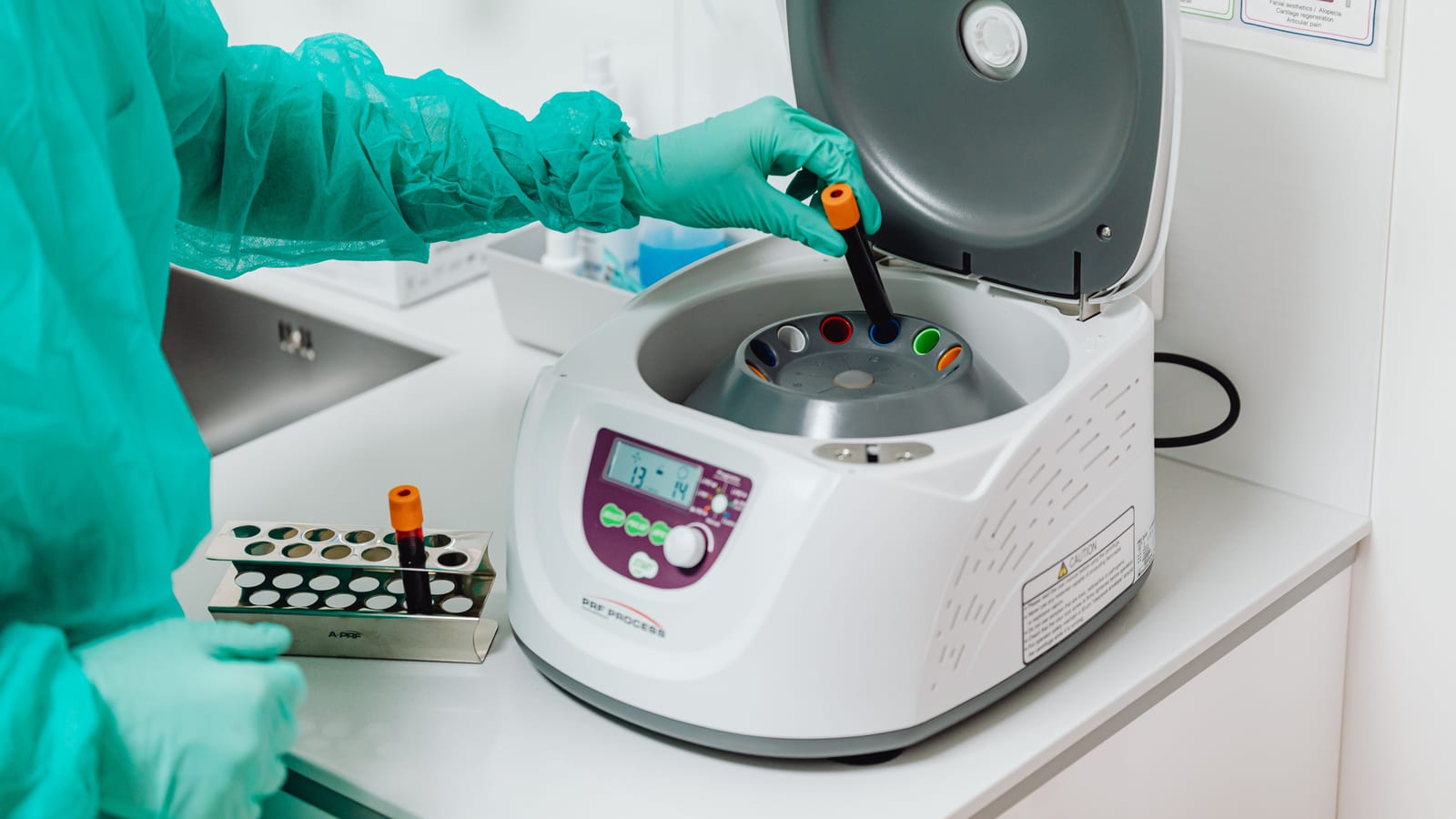
Platelet-rich plasma is a concentrate of your own blood. A clinician draws a small tube of blood, spins it in a centrifuge to separate platelets from red cells, and injects the platelet-rich layer back into the scalp. Platelets release growth factors, PDGF, VEGF, IGF-1, TGF-beta, that signal hair follicles to extend their growing phase and produce thicker shafts.
For a broader look at how PRP is used across hair and skin indications, see our PRP therapy guide.
How does PRP work for hair?
Three mechanisms matter in androgenetic alopecia (pattern hair loss):
- Anagen prolongation. Growth factors push miniaturized follicles back into a longer growth phase, so individual hairs grow longer and thicker before shedding.
- Dermal papilla activation. PRP appears to upregulate signaling in the cells at the base of the follicle that drive new hair-shaft production.
- Vascular support. VEGF helps build the small blood vessels that supply the follicle, giving it more oxygen and nutrients.
None of these mechanisms regrows a follicle that has been gone for a decade. PRP rescues follicles that are still alive but miniaturized, which is most of what you have in pattern thinning.
What does the research actually show?
The strongest evidence is in androgenetic alopecia. A widely cited meta-analysis pooling randomized trials found a statistically significant increase in hair density and thickness with PRP versus placebo across studies (Gupta & Bamimore, J Cutan Aesthet Surg 2019). The effect size is meaningful but modest, typically a 20-to-30 hairs-per-square-centimeter improvement in trial protocols.
Subsequent reviews and a 2020 systematic review have echoed this finding while flagging the heterogeneity in PRP preparation methods, different centrifuge speeds, single- versus double-spin, activator versus no activator. Translation: protocol matters, and a “PRP” treatment at one clinic may not be the same product at another.
Evidence outside androgenetic alopecia is thinner. PRP has been studied for alopecia areata with mixed results. For scarring alopecias (lichen planopilaris, frontal fibrosing) the data is weaker and inflammation control comes first.
Who responds best to PRP for hair loss?
The strongest responders share several traits:
- Early to moderate loss (Norwood 2 to 4 in men, Ludwig I to early II in women)
- Diffuse thinning rather than fully bald patches. There must be miniaturized follicles still present to rescue
- Women with female-pattern hair loss who cannot or do not want to take finasteride
- Men with crown thinning as an adjunct to finasteride and minoxidil
- Post-partum or telogen effluvium patients in some cases (though most resolve spontaneously)
Poor candidates: completely smooth bald scalp, active scarring alopecia, untreated thyroid disease, severe iron deficiency, or active scalp infection. Underlying drivers should be addressed first.
What is a realistic PRP protocol?
- Loading phase: 3 to 4 sessions, 4 to 6 weeks apart
- Re-assessment: photographs at month 3 and month 6 (hair cycles are long, earlier is too soon)
- Maintenance: one session every 4 to 6 months indefinitely, or a top-up loading series annually
Each session takes about 45 to 60 minutes. Topical anesthetic blunts the discomfort, and most patients describe the injections as a sharp tingling rather than true pain. There is mild redness and tenderness for 24 to 48 hours.
For pricing context, see our breakdown of PRP injection cost.
PRP vs minoxidil vs finasteride
This is the most common question, and the honest answer is that they do different jobs and stack well together.
Real-world experience: most patients who do best are on minoxidil daily plus PRP every 4 to 6 months, with finasteride added if the patient is a candidate and consents to it. PRP alone is rarely the strongest plan; PRP layered onto medical therapy outperforms either alone in clinical practice.
What does PRP for hair loss feel like and recovery?
- Day of: Topical numbing, blood draw (1 tube), 20 to 30 minutes of injections, slight pressure dressing.
- Day 1 to 2: Tenderness, mild swelling, occasional bruising at injection sites.
- Week 2: A short increase in shedding is normal and a sign that the cycle is resetting, not a failure.
- Month 3: Subtle thickening, less shedding, sometimes new fine “vellus” hairs visible at the part line.
- Month 6: Photographic re-evaluation; this is when the response is judged.
Patients local to South Orange County can read our PRP hair restoration page for Mission Viejo for clinic-specific details.
Side effects and safety
Because PRP uses your own blood, allergic reactions are essentially nonexistent. The realistic side effects are:
- Scalp tenderness, mild swelling, transient bruising
- Headache for 24 hours in a subset of patients
- Pinpoint bleeding at injection sites
- Rare: infection (minimized by sterile technique), vasovagal reaction during blood draw
PRP is generally contraindicated in active hematologic disease, anticoagulant therapy that cannot be paused, active malignancy, or local scalp infection.
How long do results last?
Without maintenance, PRP benefits fade over 9 to 12 months. With a maintenance plan, results can be sustained for years. The underlying biology of androgenetic alopecia does not change, PRP is a counterweight against an ongoing process, not a cure.
Frequently asked questions
How many PRP sessions do I need before I will know if it is working?
Three loading sessions and a 6-month photographic comparison. Anyone judging results at month 2 is rushing the hair cycle.
Can PRP regrow hair on a fully bald scalp?
No. PRP rescues follicles that are still alive. A scalp that has been smooth for years usually needs a surgical hair transplant if regrowth is the goal.
Is PRP better than minoxidil?
They do different jobs. For most patients, the strongest plan is daily minoxidil combined with PRP every 4 to 6 months, not one or the other.
Will I shed after PRP?
A short increase in shedding around weeks 2 to 4 is common and a sign that follicles are resetting their cycle. It is not a failure.
Does PRP work for women with hair loss?
Yes, particularly women with diffuse female-pattern thinning who cannot or do not want to take finasteride. Response is usually strongest at the part line.
Is one type of PRP better than another?
Protocols vary. Double-spin systems that produce higher platelet concentrations have stronger evidence than basic single-spin office systems. Ask the clinic what platelet multiplier their system produces.
How much does PRP for hair loss cost?
In Orange County, expect roughly 600 to 1,200 dollars per session, with most patients budgeting 1,800 to 4,500 dollars for the first year including loading and maintenance.
Talk to a clinician at OC Weight Loss and Medspa
If you have been thinning for a while and want a clear-eyed read on whether PRP is a fit, we will walk through your pattern, labs, and current routine before recommending anything. Visit our PRP hair restoration page or book below.
Book a free consultation
Related treatments at our Mission Viejo clinic
Not sure which treatment fits? These are the related services our clinicians most often discuss at a consultation.
- PRP Therapy for Hair Growth and Skin Rejuvenation, Discover PRP therapy to boost hair growth, improve skin texture, and stimulate collagen using your body’s natural healing process safely.
- Face Rejuvenation for Youthful Radiant Skin Today, Revitalize your look with face rejuvenation treatments.
- Peptide Therapy in Orange County, Clinician-supervised peptide therapy in Mission Viejo: Ipamorelin, NAD+, GLOW Blend, BPC-157.
References
- Platelet-Rich Plasma for Androgenetic Alopecia: A Systematic Review and Meta-Analysis of Randomized Controlled Trials — J Cutan Med Surg 2023, via PubMed
- Platelet-rich plasma as a therapy for androgenic alopecia: a systematic review and meta-analysis — J Dermatolog Treat 2022, via PubMed
- Use of autologous platelet-rich plasma in androgenetic alopecia in women: a systematic review and meta-analysis — J Dermatolog Treat 2023, via PubMed